
- Updated September 16, 2026
- 15-minute read
- Reviewed by Ajeet Samani
Quick Answer
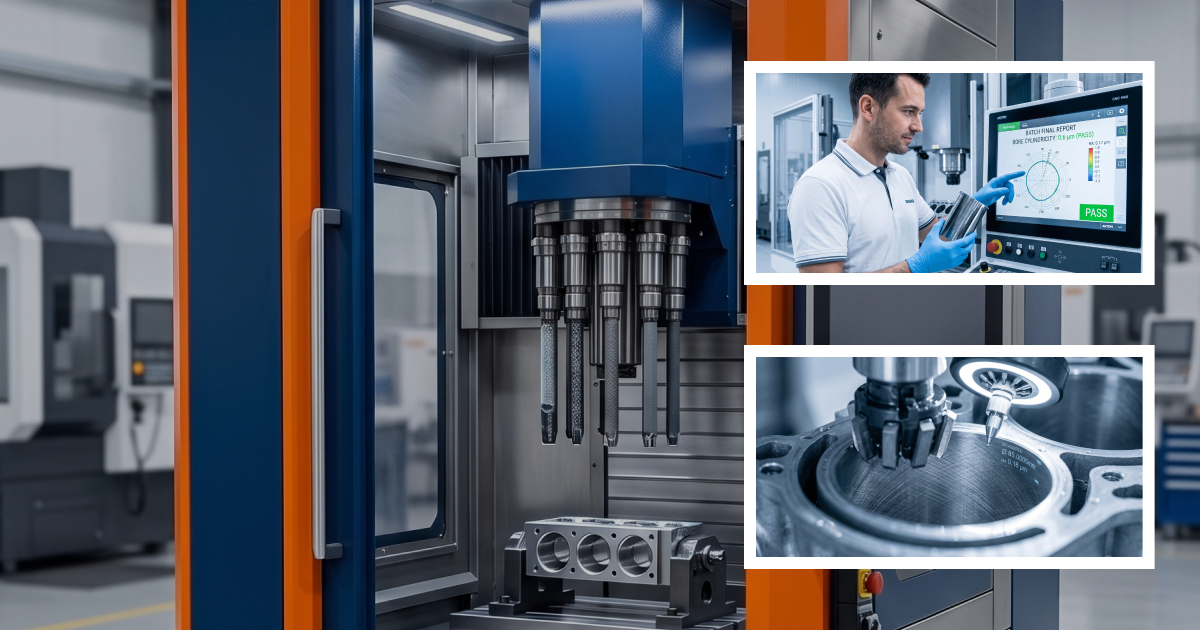
A CNC honing machine achieves micron-level bore accuracy through controlled honing movements, precision tooling, consistent process parameters, stable workholding, and proper input conditions. When these factors are correctly established, CNC honing can deliver highly consistent bore dimensions, geometry, and surface finish. Khushbu Engineers states that its SP650 Six Spindle Honing Machine can produce 5,000 parts a day with 2-micron bore accuracy with the right input.
Precision bore finishing is critical in manufacturing applications where small variations in bore dimensions or geometry can affect component performance. For automotive, hydraulic, aerospace, defense, and other precision applications, manufacturers need more than a bore that simply meets its nominal diameter. They also need consistency, surface quality, and repeatable results throughout production.
This is where CNC honing machines play an important role. By combining CNC-controlled machine movements with precision honing tools and controlled production parameters, CNC honing provides a repeatable approach to finishing internal bores.
What Is Bore Accuracy?
Bore accuracy refers to how closely a finished internal bore meets its specified dimensional and geometric requirements. It is not limited to the diameter of the bore.
Depending on the application, manufacturers may need to control several characteristics, including:
- Bore diameter
- Roundness
- Cylindricity
- Straightness
- Taper
- Bore geometry
- Surface finish
A bore can have the correct diameter at one measurement point but still have variations along its length. For this reason, precision bore finishing requires control over the complete geometry and surface condition of the bore.
This is particularly important for components where the bore interacts with another component, supports movement, retains lubrication, or contributes to sealing performance.
What Is CNC Honing?
CNC honing is a precision bore-finishing process that uses computer-controlled machine movements and abrasive honing tools to improve bore dimensions, geometry, and surface finish.
Honing is generally performed as a finishing operation after an earlier machining process has created the basic bore.
During honing, abrasive elements interact with the internal surface of the bore and remove a controlled amount of material. The process can help improve characteristics such as roundness, straightness, dimensional consistency, and surface finish.
The CNC aspect adds controlled and repeatable machine movements to the honing process. This is particularly valuable when the same finishing requirements need to be maintained across a large number of components.
How Does a CNC Honing Machine Achieve High Bore Accuracy?
A CNC honing machine achieves high bore accuracy by controlling the machine movement, honing tool, process parameters, workholding, and finishing conditions as part of one coordinated process.
Several factors contribute to the final result.
CNC-Controlled Machine Movement
CNC control allows the honing operation to follow an established process sequence consistently.
Instead of relying heavily on manual adjustments for repetitive operations, the machine can perform defined movements and process steps repeatedly. This helps reduce variation between production cycles.
For high-volume manufacturing, repeatability is especially important because the objective is not simply to produce one accurate component. The process needs to produce a consistent result across the entire production run.
Precision Honing Tools
The honing tool has a direct effect on the internal bore, so tool selection is an important part of achieving the required accuracy.
Tooling needs to be appropriate for factors such as:
- Component material
- Bore size
- Required stock removal
- Surface-finish requirements
- Dimensional requirements
- Production volume
The machine itself cannot guarantee the required result if the tooling or process setup is unsuitable for the component.
This is why machine capability, tooling, and process development need to be considered together.
Stable Workholding
Consistent workholding helps maintain the correct position of the component during the honing operation.
If the component moves or is positioned inconsistently, it can introduce variation into the finished bore.
For production applications, repeatable workholding is particularly important because each component should enter the honing operation under consistent conditions.
Controlled Material Removal
Honing is primarily a precision finishing operation. The objective is to remove a controlled amount of material and improve the bore without unnecessarily changing the component.
The amount of material that can be removed depends on the condition of the bore entering the honing operation, the tooling, the material, and the process parameters.
A properly established CNC honing process helps maintain consistency in how this finishing operation is performed.
What Factors Affect CNC Honing Accuracy?
The main factors include machine capability, tooling, abrasive selection, workholding, process parameters, input bore condition, CNC control, and measurement. These elements need to work together to achieve repeatable bore accuracy.
Why Is Surface Finish Important in Bore Finishing?
Surface finish is an important part of bore quality because the internal surface can influence lubrication, wear, sealing, friction, and the interaction between mating components.
Honing is used not only to achieve dimensional requirements but also to improve the internal surface condition of a bore.
The honing process can create a controlled surface texture, including the characteristic cross-hatch pattern associated with honing.
However, the required surface finish depends on the component and its application. A surface finish that is appropriate for one component may not be appropriate for another.
Therefore, the honing process needs to balance:
- Dimensional accuracy
- Bore geometry
- Surface finish
- Material removal
- Process consistency
A bore that meets a dimensional target but does not meet the required surface-finish specification may still fail to deliver the desired component performance.
Why Is Process Consistency Important for Micron-Level Accuracy?
Process consistency is essential because achieving micron-level accuracy on one component is different from maintaining that accuracy across an entire production batch.
In high-volume manufacturing, even a small amount of variation can become significant when repeated across thousands of components.
CNC-controlled processes can help maintain consistent machine movements and established process parameters from one cycle to another.
This makes CNC honing particularly relevant for manufacturers that need repeatable bore finishing rather than occasional precision results.
Khushbu Engineers states that its multi-spindle single-pass honing machines can produce 5,000 parts a day with 2-micron bore accuracy with pre-determined input conditions.
The qualification regarding input conditions is important because the achievable result depends on the complete honing process and the component being processed.
Can a CNC Honing Machine Achieve 2-Micron Bore Accuracy?
Yes. Khushbu Engineers states that its SP650 Six Spindle Honing Machine can produce 5,000 parts a day with 2-micron bore accuracy with the right input. The actual result depends on the component, input condition, tooling, machine configuration, and established honing process.
The SP650 is described by Khushbu Engineers as a CNC-controlled, six-spindle vertical progressive honing machine with six honing spindles and eight fixture stations. Two additional stations are provided for part loading and unloading.
This configuration is designed for production environments where accuracy and productivity need to work together.
It is important to understand that the 2-micron figure should not be interpreted as a universal accuracy level for every component or every CNC honing machine. The manufacturer’s stated result is associated with the appropriate input conditions.
For manufacturers evaluating a honing solution, the machine should therefore be assessed according to the actual component, bore specification, material, input condition, tooling, and production requirements.
How Does Automation Improve CNC Honing?
Automation can improve production consistency by reducing unnecessary manual intervention and allowing repetitive operations to follow an established process.
Depending on the machine and application, CNC honing systems can incorporate production-oriented features such as:
- Multiple honing spindles
- Progressive honing operations
- Fixture stations
- Automated or organized loading and unloading
- Repeatable machining cycles
Khushbu’s product range includes four-spindle and six-spindle honing machines as well as specialized taper-bore and cam-profile honing machines.
For example, the company’s SP650 is a six-spindle vertical progressive honing machine with eight fixture stations, including two stations for part loading and unloading.
The appropriate level of automation depends on the component, production volume, cycle requirements, and overall manufacturing process.
What Are the Benefits of CNC Honing Machines?
The main benefits of CNC honing include repeatable bore finishing, improved process consistency, controlled material removal, surface-finish improvement, and suitability for high-productivity manufacturing.
Key benefits include:
Improved Repeatability
CNC-controlled movements allow established process parameters to be repeated across production cycles.
Consistent Bore Quality
A properly developed process can help maintain dimensional and geometric consistency across components.
Controlled Surface Finish
Honing can improve the internal surface condition of the bore while supporting the required finishing specification.
Production Productivity
Multi-spindle and progressive configurations can support high-volume manufacturing requirements.
Reduced Manual Intervention
CNC control can reduce the need for repeated manual adjustments during standardized production cycles.
Better Process Control
A defined CNC process provides greater control over how the honing operation is performed.
The exact benefits depend on the machine configuration, component requirements, tooling, and production environment.
Which Industries Use CNC Honing Machines?
CNC honing machines are used in industries where precision bore finishing and consistent production are important.
Khushbu Engineers identifies the following major sectors:
- Auto components
- Hydraulics
- Aerospace
- Defense
- Refrigeration
Khushbu’s listed automotive applications include connecting rods, rocker arms, gears, gear shifter forks, transmission parts, differential cases, valve guides, bearing housings for turbochargers, levers, and roller tappets.
Its listed hydraulic applications include valves, pumps, spools, and cam profile honing.
Different industries and components can have very different bore requirements, which is why machine configuration and process development need to be matched to the application.
Why Is CNC Honing Important in Automotive Manufacturing?
CNC honing is important in automotive manufacturing because many components require consistent bore dimensions, geometry, surface finish, and repeatable production quality.
Components such as connecting rods, rocker arms, gears, valve guides, and transmission parts can require precise internal finishing.
For automotive manufacturers operating at production scale, maintaining the required bore quality across the production run is particularly important.
This is where the combination of CNC control, appropriate tooling, stable workholding, and repeatable process parameters becomes valuable.
For a detailed discussion of automotive applications, see Why Honing Is the Preferred Bore Finishing Process in Automotive Manufacturing.
What Common Problems Can Affect Honing Accuracy?
Common honing problems can include taper, bell-mouth, inconsistent bore geometry, poor surface finish, chatter marks, and dimensional variation.
These problems can result from different parts of the manufacturing process, including:
- Incorrect or worn tooling
- Inconsistent workholding
- Unsuitable process parameters
- Machine conditions
- Incorrect input bore condition
- Inadequate process control
CNC control can help maintain repeatable machine movements and process parameters, but it does not automatically eliminate every potential honing defect.
The complete process needs to be properly established, monitored, and maintained.
CNC Honing vs. Grinding: Which Process Is Better?
CNC honing and grinding serve different manufacturing requirements, so neither process is universally better. CNC honing is particularly suited to precision bore finishing, while process selection should ultimately depend on the component, material, required tolerances, surface finish, stock removal, and production requirements.
Honing is generally used as a precision finishing process for internal bores.
Grinding has different process characteristics and can be appropriate for other manufacturing requirements.
When comparing the two processes, manufacturers should consider:
- Required bore accuracy
- Bore geometry
- Surface finish
- Material
- Amount of material to be removed
- Component design
- Production volume
How Should You Choose a CNC Honing Machine?
The right CNC honing machine should be selected according to the component, bore dimensions, required accuracy, surface finish, production volume, tooling, machine configuration, input condition, and automation requirements.
Before selecting a machine, manufacturers should evaluate:
Bore Dimensions
What bore diameter, length, and geometry need to be finished?
Accuracy Requirements
What dimensional and geometric tolerances must the finished bore meet?
Surface Finish
What surface-finish specification is required for the application?
Production Volume
Is the machine intended for low-, medium-, or high-volume production?
Machine Configuration
Would a four-spindle, six-spindle, vertical, progressive, taper-bore, or cam-profile configuration be suitable for the application?
Tooling
What honing tools and abrasive solutions are appropriate for the component material and finishing requirements?
Input Condition
What is the condition of the bore before honing, and what finishing stock is available?
Automation
What level of production automation is required?
Inspection
How will the finished bore be measured and verified?
Technical Support
Can the manufacturer support the machine selection and honing process according to the specific application?
The right machine should therefore be selected as part of a complete production solution rather than based on one specification alone.
What CNC Honing Machines Do Khushbu Engineers Offer?
Khushbu’s current product range includes several honing solutions designed for different production and component requirements. The official product listing includes four-spindle, six-spindle, taper-bore, and cam-profile honing solutions.
SP450 Four Spindle Honing
The SP450 Four Spindle Honing is described by Khushbu Engineers as a high-precision multi-spindle system designed for high productivity, with applications including automotive components and engine cylinder block applications.
SP425 Four Spindle Honing
The SP425 Four Spindle Honing is described as a CNC-controlled progressive single-pass vertical machine optimized for small-bore components and production accuracy.
SP650 Six Spindle Honing
The SP650 Six Spindle Honing is a CNC-controlled six-spindle vertical progressive honing machine with six honing spindles and eight fixture stations. Khushbu Engineers states that with the right input, it can produce 5,000 parts a day with 2-micron bore accuracy.
SP625 Six Spindle Honing
The SP625 Six Spindle Honing is described by Khushbu Engineers as a progressive vertical multi-spindle setup designed for fast cycle times and micro-finish results on small diameters.
VH150 Taper Bore Honing
The VH150 Taper Bore Honing is a specialized honing solution for taper-bore applications. Khushbu’s product listing positions it for applications involving intricate profiles and precision requirements.
VH500 Cam Profile Honing
The VH500 Cam Profile Honing is a specialized solution designed for cam-profile honing and finishing of specialty mechanical components.
This range allows manufacturers to consider different honing configurations according to component geometry, bore requirements, production volume, and application.
Why Choose Khushbu Engineers for CNC Honing Solutions?
Khushbu Engineers was established in 1994 and is an ISO 9001:2015 certified company, according to its official About page. The company states that it indigenously developed a multi-spindle CNC single-pass honing machine for the first time in India in 2005.
Khushbu Engineers is based in Kolhapur, Maharashtra, India, and focuses on honing and bore-finishing solutions. The company states that its machines are developed with a focus on quality, productivity, and process reliability.
Its product portfolio includes CNC single-pass honing machines along with other honing solutions, allowing the company to serve different bore-finishing applications.
Frequently Asked Questions About CNC Honing Machines
What is a CNC honing machine?
A CNC honing machine is a computer-controlled machine used for precision finishing of internal bores. It uses controlled machine movements and honing tools to improve bore dimensions, geometry, and surface finish.
How accurate can a CNC honing machine be?
Can CNC honing achieve micron-level accuracy?
What affects CNC honing accuracy?
What is CNC honing used for?
CNC honing is used for precision bore finishing across applications including automotive components, hydraulics, aerospace, defense, and refrigeration.
Does CNC honing improve surface finish?
Can CNC honing be used for high-volume production?
What is the difference between CNC honing and grinding?
Conclusion
Micron-level bore accuracy is achieved through control of the complete honing process. CNC machine movement, tooling, workholding, process parameters, input conditions, surface-finish requirements, and inspection all contribute to the final result.
A CNC honing machine can provide the repeatability and process control required for precision bore finishing, particularly in production environments where consistent results are important.
Khushbu’s stated capability of achieving 2-micron bore accuracy with the right input on its SP650 six-spindle honing machine, along with its range of four-spindle, six-spindle, taper-bore, and cam-profile honing solutions, positions its CNC honing machines for a range of precision manufacturing applications.
Explore Khushbu Engineers CNC Honing Machines to find a honing solution suited to your component, bore specifications, accuracy requirements, and production needs.