
- Updated November 18, 2026
- 14-minute read
- Reviewed by Ajeet Samani
Quick Answer
Neither CNC honing nor grinding is universally better for precision components. The right process depends on what needs to be achieved. CNC honing is primarily used for final bore finishing where bore geometry and functional surface characteristics are important, while grinding is a broader abrasive machining process used for finishing internal or external surfaces and can be selected when the component and machining requirements call for it. The best choice should always be based on the component design, tolerance requirements, surface finish, material, stock removal, and production process.
When manufacturers evaluate finishing operations, the question is rarely whether honing is better than grinding in every situation. The more practical question is which process is better suited to this particular component.
Both processes are widely used in precision manufacturing, but they serve different purposes. Choosing the correct finishing method can influence dimensional quality, production efficiency, tooling strategy, and the overall manufacturing workflow.
This guide compares CNC honing vs grinding from an engineering and production perspective to help manufacturers make a more informed process-selection decision.
What Is CNC Honing?
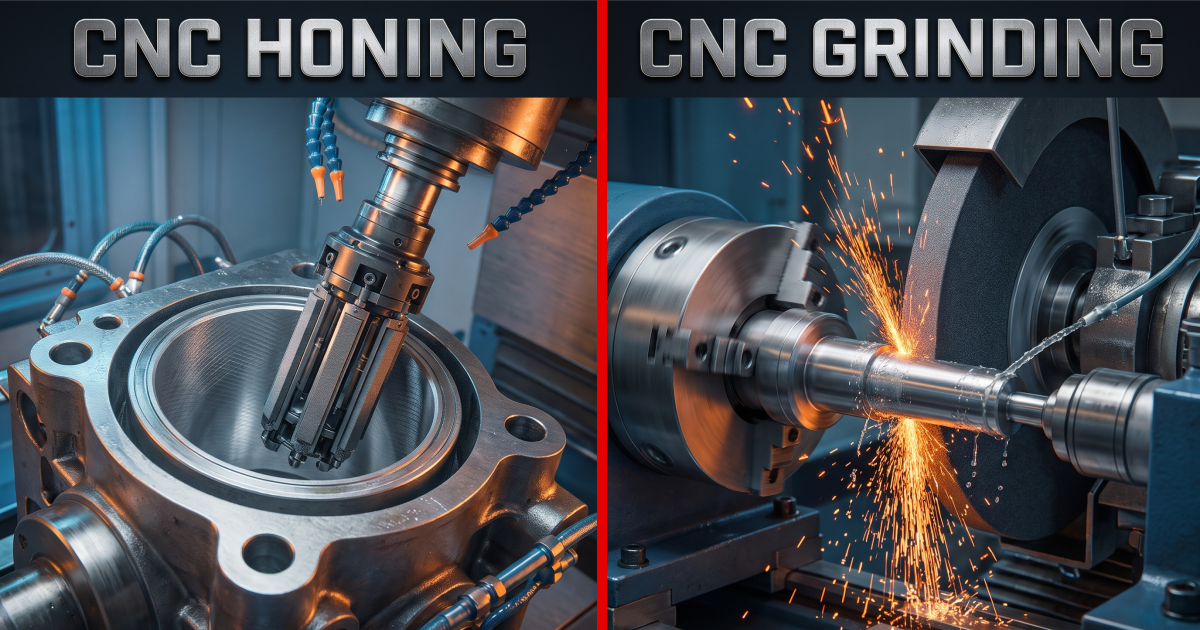
CNC honing is a precision finishing process used primarily for improving the internal surface of cylindrical bores.
The honing operation removes a relatively small amount of material using abrasive honing tools while improving characteristics such as bore geometry, roundness, straightness, and surface finish. CNC control helps maintain repeatable machine movements and consistent process parameters throughout production.
Khushbu Engineers describes honing as a low-stock-removal bore-finishing process designed to improve bore accuracy and surface quality. The process is commonly used after earlier machining operations have already created the basic bore.
Rather than creating the bore from scratch, honing focuses on refining the final internal surface and correcting minor geometric variations where required.
What Is Grinding?
Grinding is an abrasive machining process that uses a rotating grinding wheel to remove material from a workpiece.
Unlike honing, grinding is used across a much broader range of applications. It can be applied to:
- External cylindrical surfaces
- Internal diameters
- Flat surfaces
- Shafts
- Journals
- Bearing surfaces
- Complex precision profiles
Grinding can be selected at different stages of manufacturing depending on the required geometry, material, and finishing objective.
For internal components, internal grinding may be used before or instead of honing depending on the specification and manufacturing route.
This means CNC honing and grinding are often complementary processes rather than direct replacements.
CNC Honing vs Grinding: Key Differences
Comparison Factor | CNC Honing | Grinding |
Primary purpose | Final bore finishing | General precision abrasive machining |
Typical workpiece focus | Internal cylindrical bores | Internal and external surfaces |
Material removal | Small finishing stock | Can remove more material depending on the process |
Surface texture | Functional bore finish with honing pattern | Ground surface produced by grinding wheel |
Bore geometry improvement | Strongly suited for correcting minor bore geometry issues | Depends on grinding setup and application |
Tooling | Honing head with abrasive stones or tools | Grinding wheel |
Motion | Rotational and reciprocating or single-pass depending on process | Rotating grinding wheel with controlled feed |
Process selection | Bore-focused finishing applications | Wider range of precision machining applications |
The comparison shows that the two processes are designed around different manufacturing objectives rather than competing for exactly the same role.
When Is CNC Honing the Better Choice?
CNC honing is generally the better choice when the primary objective is precision finishing of an internal bore with close attention to bore geometry and functional surface quality.
Honing is especially relevant when manufacturers need to refine an already machined bore instead of performing major material removal.
Typical situations include components where the internal bore plays an important functional role in movement, sealing, lubrication, or fitment.
Engineers may consider CNC honing when they require:
- Precision internal bore finishing
- Improved roundness and straightness
- Controlled surface texture
- Consistent bore quality across production
- Repeatable finishing operations
The process is particularly associated with cylindrical internal features rather than general external machining.
Khushbu Engineers’s honing solutions are specifically focused on bore-finishing applications across industries such as automotive, hydraulics, aerospace, defense, and refrigeration.
When Is Grinding the Better Choice?
Grinding is generally the better choice when the component requires precision machining of surfaces beyond internal bore finishing or when the manufacturing process is designed around grinding as the appropriate abrasive operation.
Grinding is commonly used for components requiring accurate finishing of:
- External shafts
- Flat surfaces
- Bearing journals
- Internal diameters
- Hardened materials
- Precision cylindrical surfaces
The process is highly versatile because it can address both internal and external machining requirements depending on the machine configuration.
For manufacturers, this versatility makes grinding an important finishing process across many industries.
However, when the primary requirement is refining the final characteristics of a precision bore, honing may offer advantages that are specifically related to bore finishing rather than general abrasive machining.
How Do Accuracy Requirements Differ?
One of the biggest misconceptions is that either honing or grinding automatically produces better accuracy in every application.
The reality is more nuanced.
Both processes are capable of precision manufacturing, but they contribute differently to the final component depending on the workpiece and machining objective.
CNC honing is primarily associated with improving internal bore geometry and achieving a controlled finishing condition inside cylindrical bores.
Grinding can also achieve highly accurate dimensions, particularly for external surfaces and precision internal grinding applications.
The correct decision should therefore begin with the engineering drawing.
Manufacturers should first identify:
- Which feature requires finishing?
- Is it an internal bore or another surface?
- What geometric tolerances are required?
- What surface characteristics are functionally important?
The answers are more useful than asking which process is inherently more accurate.
How Does Surface Finish Compare?
CNC honing and grinding produce different surface characteristics because the two processes use different abrasive motions and tooling systems. The required surface should be selected according to the component’s functional requirements rather than appearance alone.
Surface finish is not simply about making a surface smoother.
For precision components, surface texture can influence:
- Lubrication
- Wear behavior
- Friction
- Sealing performance
- Contact between mating parts
Khushbu Engineers explains that the honing process improves surface finish while also refining bore characteristics such as roundness and straightness.
Honing is also known for producing a characteristic cross-hatch texture in conventional bore-finishing applications.
Grinding produces a different surface pattern because material is removed using a rotating grinding wheel rather than a honing tool.
Neither surface is automatically superior.
The engineering requirement should determine which finishing characteristic is appropriate.
Which Process Removes More Material?
Grinding is generally selected when greater material removal is required, while honing is primarily a finishing process involving comparatively small stock removal.
This distinction is important because finishing operations are usually planned according to the amount of material remaining after previous machining stages.
A typical manufacturing sequence may include:
- Drilling
- Boring
- Reaming or internal grinding where required
- Honing as the final bore-finishing operation
However, the sequence depends entirely on the component and production method.
Honing should not be viewed as a replacement for every machining operation because it is designed around finishing rather than heavy stock removal.
Likewise, grinding should not automatically be replaced with honing when the component requires another type of abrasive machining.
How Do Tooling Costs Compare?
Tooling costs vary according to the component, production volume, material, machine configuration, and process design, so there is no universal rule that honing or grinding is always less expensive.
This is an important commercial consideration because tooling should be evaluated as part of the entire manufacturing process.
For CNC honing, tooling considerations include:
- Honing stones or abrasive tools
- Tool specification
- Abrasive material
- Bore diameter
- Tool wear
- Required finishing quality
For grinding, tooling considerations include:
- Grinding wheel type
- Wheel material
- Wheel dressing requirements
- Workpiece material
- Internal or external grinding setup
- Precision requirements
Instead of comparing tooling prices alone, manufacturers should evaluate the total process cost including setup, tooling life, maintenance, cycle requirements, inspection, and expected production volume.
A process with a higher initial tooling cost may still be commercially appropriate if it better matches the production requirement.
Which Process Offers Better Cycle Time?
Cycle time is one of the most searched comparison factors, but it should be approached carefully.
There is no single cycle-time winner between CNC honing and grinding.
Cycle time depends on variables such as:
- Component geometry
- Bore size
- Material
- Stock removal
- Number of operations
- Tooling
- Machine configuration
- Production quantity
- Automation level
- Loading and unloading method
For example, a high-volume production line may optimize cycle time through specialized machine configurations, while another application involving a precision external shaft may be better suited to grinding.
The correct engineering approach is to compare the entire manufacturing cycle, not only the machining time of one operation.
Manufacturers should therefore evaluate cycle time alongside throughput, quality requirements, tooling, and production planning.
CNC Honing vs Grinding for Automotive Components
Automotive manufacturing uses both honing and grinding because different components require different finishing methods.
Khushbu Engineers identifies automotive applications for its honing solutions including components such as:
- Connecting rods
- Rocker arms
- Gears
- Gear shifter forks
- Transmission components
- Differential cases
- Valve guides
- Bearing housings
Many of these applications involve precision internal bores where honing becomes an important finishing operation.
Grinding also remains widely used throughout automotive manufacturing for shafts, journals, flat precision surfaces, and other features depending on the component design.
Therefore, the choice should be made according to the specific feature being manufactured rather than the industry alone.
A single automotive component may even involve multiple machining processes before reaching its final specification.
CNC Honing vs Grinding for Hydraulic Components
Hydraulic components frequently depend on precision internal bores because dimensional consistency and surface quality can influence component fit and operational performance.
Khushbu Engineers lists hydraulic applications including:
- Valves
- Pumps
- Spools
- Cam-profile honing applications
For these components, honing may be selected when the internal bore requires final precision finishing.
Grinding may still be used elsewhere in the manufacturing process depending on the component geometry and engineering requirements.
Again, the two processes should be viewed as complementary manufacturing options rather than mutually exclusive technologies.
Which Process Is Better for Bore Geometry?
For final cylindrical bore finishing, CNC honing is specifically designed to improve bore geometry such as roundness, straightness, and consistency.
This is one of the strongest reasons honing is used in precision bore manufacturing.
Minor geometric imperfections created during previous machining stages can sometimes be refined during the honing operation.
Grinding also delivers precision results, but its role depends on the type of grinding process being performed.
When the engineering objective is specifically focused on the final internal bore, honing is often the more targeted finishing solution.
When the objective involves other precision surfaces or broader material-removal requirements, grinding may be more appropriate.
How Should Manufacturers Choose Between CNC Honing and Grinding?
The best process begins with the engineering requirement rather than the machine.
Manufacturers should evaluate the following questions.
What Feature Needs Finishing?
Is the component primarily an internal cylindrical bore, an external shaft, a flat surface, or another precision feature?
How Much Material Must Be Removed?
If significant material removal is still required, grinding or another machining operation may be more suitable before final finishing.
What Geometry Is Critical?
Determine whether the priority is:
- Bore roundness
- Straightness
- Cylindricity
- Surface texture
- External concentricity
- Flatness
- Journal accuracy
Different processes are optimized for different requirements.
What Surface Characteristics Are Required?
Surface finish should be selected according to the functional application rather than simply choosing the smoothest possible finish.
What Is the Production Volume?
Production planning affects machine configuration, tooling strategy, automation, and overall process economics.
What Is the Complete Manufacturing Route?
Instead of comparing only two machines, evaluate where each process fits within the complete production sequence.
This often leads to a more efficient manufacturing decision.
Decision Guide: CNC Honing or Grinding?
If Your Priority Is… | Consider |
Final precision finishing of an internal bore | CNC Honing |
Improving bore roundness and straightness | CNC Honing |
Functional bore surface characteristics | CNC Honing |
Precision finishing of external shafts or journals | Grinding |
Flat or external precision surfaces | Grinding |
Internal or external abrasive machining depending on geometry | Grinding |
Bore-focused finishing after previous machining | CNC Honing |
Process selection based on complete component design | Evaluate both |
This guide should be used as an initial engineering reference rather than a replacement for application-specific process evaluation.
Can Honing and Grinding Be Used Together?
Yes.
In many manufacturing environments, grinding and honing are not competing processes—they can be consecutive operations within the same production route.
A component may first undergo machining or grinding to establish the required geometry before honing performs the final internal bore finishing.
This is particularly relevant when manufacturers need different surface characteristics on different features of the same component.
Instead of asking whether one process replaces the other, engineers should determine which process belongs at each stage of manufacturing.
That approach usually produces a more practical and efficient production strategy.
Why CNC Honing Is a Strong Choice for Precision Bore Finishing
Khushbu Engineers specializes in CNC honing and bore-finishing solutions designed for precision internal bore applications.
Its honing process is focused on refining bore geometry and surface quality through controlled abrasive finishing.
For manufacturers whose primary requirement is internal bore finishing, CNC honing provides a targeted process that can be matched to the component, tooling, and production requirement.
The decision should always remain application-driven.
The objective is not to choose honing because it is better than grinding in every case—it is to choose the process that best satisfies the engineering specification.
Frequently Asked Questions About Honing Defects
Is CNC honing more accurate than grinding?
Does honing provide a better surface finish than grinding?
What causes bell-mouth in a honed bore?
Can grinding replace honing?
Not in every application. Grinding and honing serve different manufacturing purposes, and some production routes may use both processes rather than choosing one exclusively.
Which process is better for automotive components?
Is tooling cheaper for honing or grinding?
How do I choose between honing and grinding?
Discover the Advantages of CNC Honing
CNC honing and grinding are both valuable precision finishing technologies, but they are designed for different manufacturing objectives.
If your requirement is focused on final precision bore finishing, improved bore geometry, and controlled internal surface characteristics, CNC honing may be the more suitable process. If your component requires precision machining of other internal or external surfaces, grinding may be the appropriate choice within the manufacturing route.
Khushbu Engineers develops CNC honing solutions for precision bore-finishing applications across multiple industrial sectors.